

The origin of extreme acute respiratory syndrome coronavirus 2 (SARS-CoV-2) has lengthy been debated amongst scientists. Nonetheless, prior analysis discovered early genetic materials of a singular SARS-CoV-2 variant from the soil on King George Island, Antarctica between 24 December 2018 and thirteenth January 2019. Following up on these findings, new analysis by scientists on the College of Veterinary Medication, Budapest, suggests the brand new variant is expounded to genetic materials from the mitochondria of Homo sapiens, inexperienced monkey, and Chinese language hamster and certain got here from cell strains Vero E6 in inexperienced monkeys and Chinese language hamster ovary cells, which is regularly used to review coronaviruses within the lab.
Research: Host genomes for the distinctive SARS-CoV-2 variant leaked into Antarctic soil metagenomic sequencing information. Picture Credit score: Alex. Munoz / Shutterstock
“The absence of extra exact data on the contaminator samples leaves open the probabilities that both there are identified samples which have escaped our consideration, or that there are unpublished outcomes that could be key to determine the origin of SARS-CoV-2,” concluded the analysis workforce. Nonetheless, the researchers warning that these findings are preliminary, and haven’t been confirmed as a scientific reality.
The research “Host genomes for the distinctive SARS-CoV-2 variant leaked into Antarctic soil metagenomic sequencing information” was not too long ago posted to the Analysis Sq. preprint* server. For readability, a analysis preprint is a preliminary model of a manuscript that has not accomplished the peer evaluation course of at a journal.
Research background
The Antarctic soil samples containing SARS-CoV-2 sequence fragments have been despatched to a lab in Shanghai, China, in December 2019. A phylogenetic evaluation of the samples suggests they’re early variants associated to the Pango lineage “A” characterised by uncommon mutations and a protracted deletion at nucleotide 21761.
The researchers of the present research don’t consider that SARS-CoV-2 originated in Antarctica however as a substitute have been mistakenly assigned reads from one other SARS-Cov-2 pattern sequenced on the identical move cell on the Sangon Biotech sequencing facility. That is seemingly as a result of the tools used to sequence the information is vulnerable to index hopping and misassignment errors from contaminated paired-end samples with solely the R2 mates of SARS-CoV-2.
The present research appears to be like into discovering the genetic footprint of the host harboring the found viruses.
Research particulars
The researchers hypothesized that the host or hosts’ genetic materials might have leaked into viral sequencing information as nicely. As a result of the scale of a mammalian mitochondrial genome is much like a coronavirus, the chance of excessive genome protection in a single mammalian cell is excessive as a result of they’ve 1000’s of mitochondria with their very own genome.
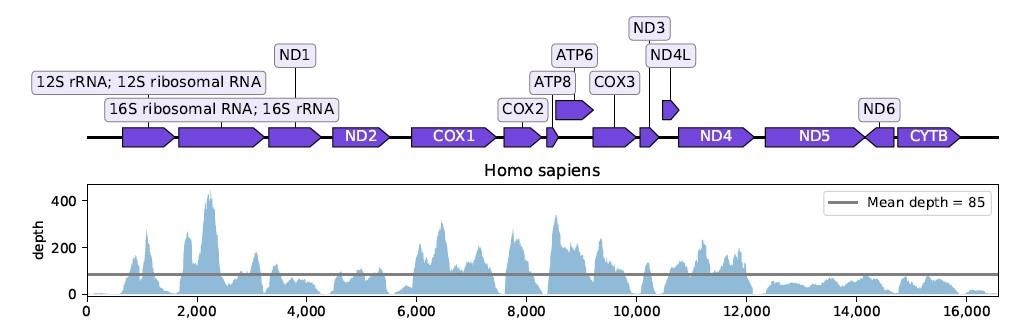
The smoothed protection of the human mitochondrial reference genome by the union of R2 reads from samples SRR13441704, SRR13441705 and SRR13441708. The typical depth is 85 however there are massive fluctuations within the protection.
The researchers used the present database containing data of all sorts of mitochondria to slim their search into mammals solely. Utilizing the time period “Vertebrata” of their taxonomy, the workforce landed 6,158 potential species. They then in contrast the vertebrate mtDNA reference genome set to the reads from viral genome samples.
To keep away from false or deceptive hits, the researchers calculated the share of nucleotides lined within the mitochondrial genome and the common variety of reads in a nucleotide (common depth) for every species
Outcomes confirmed that samples RR13441704, SRR13441705, and SRR13441708 have been essentially the most considerable in SARS-CoV-2 reads in comparison with two different samples the place researchers couldn’t discover SARS-CoV-2 reads. Samples with SARS-CoV-2 reads had extra intensive mtDNA content material.
Moreover, for sure species, the samples with SARS-CoV-2 reads had orders of magnitudes larger protection than samples that didn’t have SARS-CoV-2 reads. The additional accounts got here from the Homo sapiens, Cricetulus griseus (Chinese language hamster), and the Chlorocebus sabeu (inexperienced monkey) species.
As a result of the massive variety of mtDNA correlated with the abundance of the SARS-CoV-2 content material, the mtDNA reads seemingly got here from the identical contaminor samples. Additional, the researchers clarify that is appreciable proof to point out Homo sapiens, Cricetulus griseus, and the Chlorocebus sabeu species are hosts of the detected SARS-CoV-2.
As a result of not one of the mammals reside within the Arctic, the findings recommend SARS-CoV-2 didn’t come from Antarctica however fairly contaminated in samples of their cells.
Essentially the most possible state of affairs is that they have been contaminated cells in a lab because the Chinese language hamster is used to review different betacoronaviruses akin to MERS-CoV and SARS-CoV. The Vero cell line in inexperienced monkeys is used to review the Marburg virus.
*Necessary Discover
Analysis Sq. publishes preliminary scientific reviews that aren’t peer-reviewed and, due to this fact, shouldn’t be thought to be conclusive, information scientific follow/health-related habits, or handled as established data.
