

In a latest examine printed within the journal NPJ Digital Medication, researchers reviewed present tips on the moral implementation of Synthetic Intelligence (AI) in army and healthcare purposes. Their discussions concentrate on ‘generative AI,’ a novel know-how aimed toward effectively producing info, and makes an attempt to beat presently prevalent limitations on the moral use of the know-how. They develop and suggest a novel system for the moral software of AI to army and scientific analysis, named the “GREAT PLEA.”
Picture Credit score: CHIEW / Shutterstock
AI and the necessity for ethics
Synthetic Intelligence (AI) is the simulation of human intelligence processes by machines, particularly pc techniques. With the growing computational energy of contemporary {hardware} and the widespread adoption of good units, entry to and the adoption of AI is larger than ever. AI has percolated into and revolutionized virtually each side of contemporary human society, with machine studying instruments seeing widespread utilization in on-line commercials, scientific analysis, and army simulations.
The army sector significantly advantages from AI instruments, with the continued conflicts between Russia and Ukraine anticipated to pave the best way for autonomous AI-guided weapon techniques. Sadly, the event of AI instruments isn’t accompanied by an moral analysis of the system, with collateral damages to non-combatants or buddy forces left unconsidered.
“Seeing the fast emergence of AI and its purposes within the army, the USA Division of Protection (DOD) disclosed moral ideas for AI in 2020.”
These ideas comprise 5 important features of AI-centric ethics: duty, equitable remedy, traceability, reliability, and governance. The North Atlantic Treaty Group (NATO) adopted these ideas and expanded them to incorporate lawfulness, explainability, and bias mitigation. These moral introductions spotlight the warning distinguished army our bodies impose on AI instruments and the steps they’re taking to mitigate undesirable AI outcomes.
Just like the army significance of AI instruments, these applied sciences share comparable deserves and cautions within the medical sector. AI purposes in drugs often contain utilizing these applied sciences to assist clinicians in illness diagnoses and recommend therapies. Nevertheless, in some instances, AI has begun changing total departments of previously human workers.
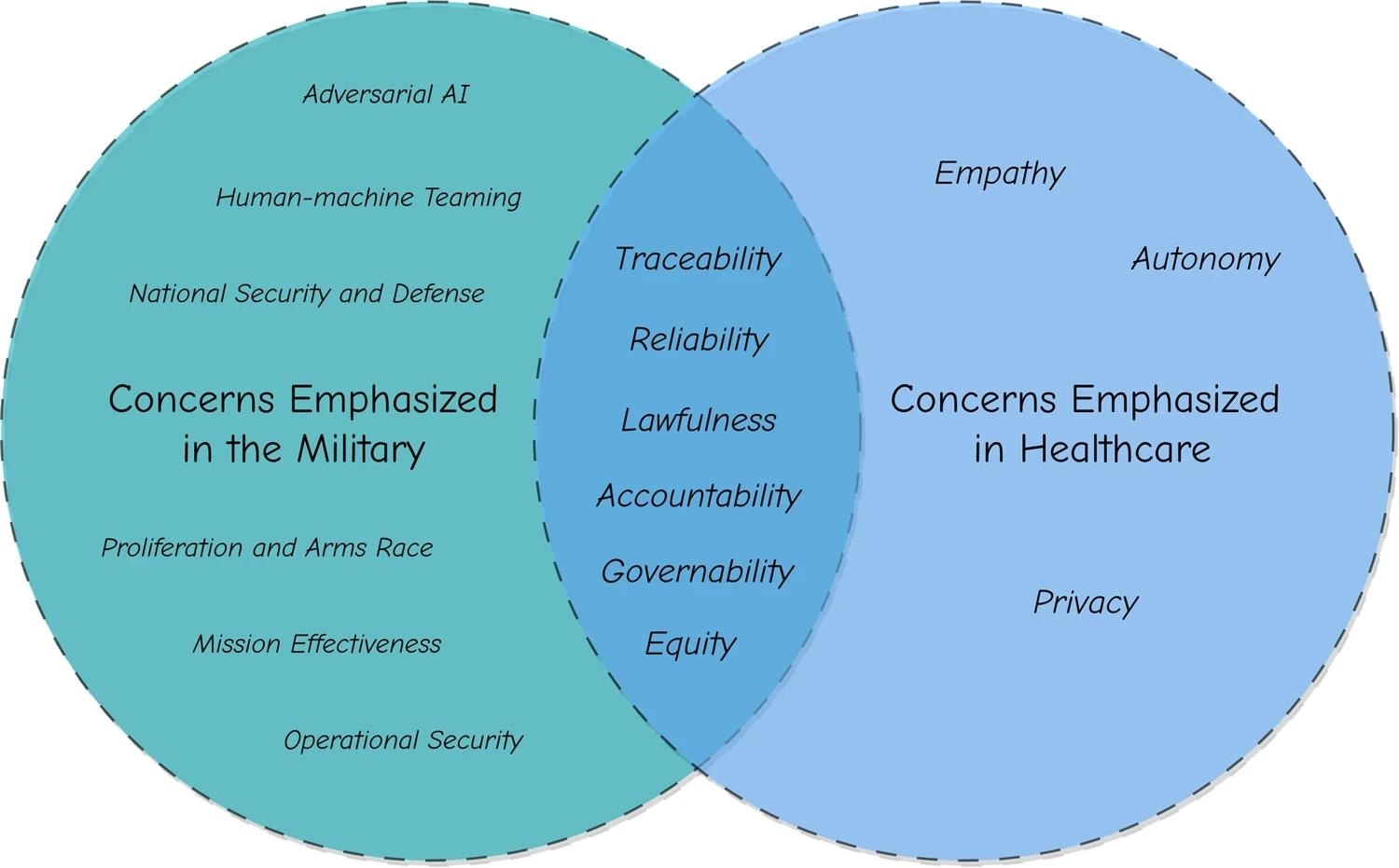 The determine illustrates the commonalities and variations in moral ideas between army and healthcare. In our evaluation, traceability, reliability, lawfulness, accountability, governability, and fairness are the moral ideas that each fields have in widespread. On the similar time, moral ideas, equivalent to empathy and privateness, are emphasised in healthcare, whereas moral ideas, equivalent to nationwide safety and protection, are emphasised within the army.
Generative AI (GenAI) is a novel sort of synthetic intelligence (AI) designed to supply new content material. It learns patterns from current information and makes use of this data to generate new outputs. Regardless of proving extraordinarily helpful in drug discovery, evidence-based drugs summarization, and tools design, these fashions are designed to optimize desired ‘black and white’ outcomes with out concern for any potential (‘gray’) collateral damages. This necessitates ethically pushed curbs on AI outcomes, which, sadly, stays under-discussed. Moreover, malicious use of AI-developed applied sciences stays not often thought of, a lot much less mentioned.
Lately, the World Well being Group (WHO) launched a doc on moral issues within the medical adoption of AI. Nevertheless, this doc stays in its nascency with a lot work, each analysis and dialogue, pending earlier than belief in AI can sufficiently enable it to take over previously human roles.
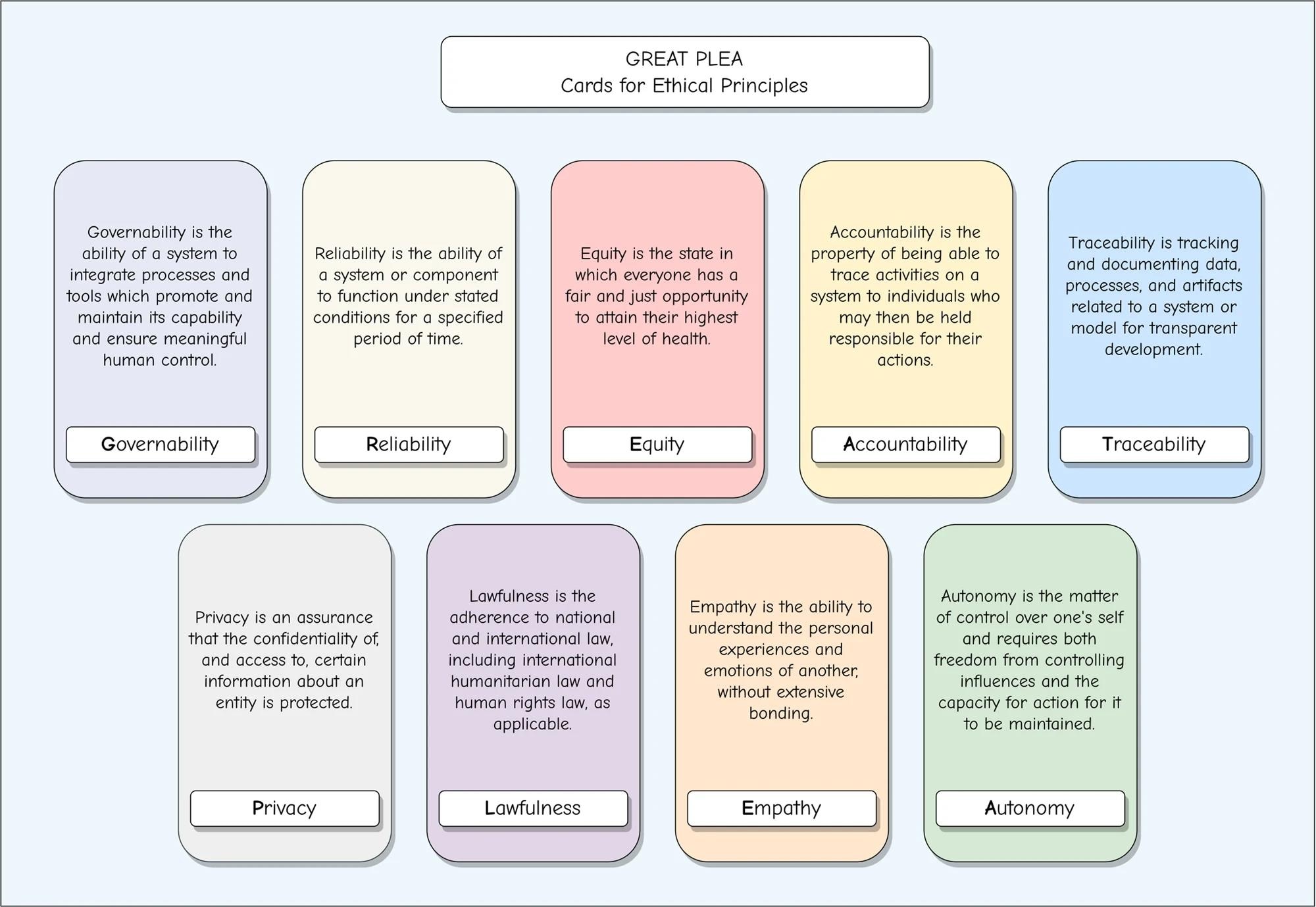 We suggest the “GREAT PLEA” moral ideas for generative AI in healthcare, particularly Governability, Reliability, Fairness, Accountability, Traceability, Privateness, Lawfulness, Empathy, and Autonomy. The GREAT PLEA moral ideas reveal our nice plea for the neighborhood to prioritize these moral ideas when implementing and using generative AI in sensible healthcare settings.
The present state of affairs
Since discussions on ethics in AI within the medical subject stay controversial and infrequently touched upon, most analysis into bias reductions and algorithm optimizations is concentrated on the army sphere. Research and studies, most notably by the RAND Company, have aimed to consolidate authorized obligations (such because the Geneva Conventions and the Regulation of Armed Battle [LOAC]) with public opinion in growing important tips for the moral improvement and use of AI algorithms, particularly generative AI.
Ongoing army analysis proposes that, whereas AI can be utilized for many army purposes, AI is presently not superior sufficient to precisely distinguish between combatants and civilians, necessitating a Human-In-The-Loop (HITL) previous to the activation of deadly weapon techniques. Concurrently, the aforementioned ideas laid out by NATO and the US DOD have allowed for the event of cutting-edge AI algorithms with moral issues baked into their code (for instance, erring on the facet of warning when collateral injury is a possible final result of a proposed motion).
“The success of those moral ideas has additionally been demonstrated by their skill to undertake and embed AI mindfully, considering AI’s potential risks, which the Pentagon is set to keep away from.”
Public opinion within the US appears confounding, with some individuals viewing the autonomous army decision-making of AI techniques favorably, whereas others don’t reconcile with the thought of AI initiating fight motion with out human authorization.
“These outcomes may very well be because of the perceived lack of accountability, which is taken into account one thing that might totally negate the worth of AI, as a totally autonomous system that makes its personal selections distances army operators or clinicians from the duty of the system’s actions.”
The GREAT PLEA for AI in scientific settings
Within the current work, the authors develop and suggest a novel system for the moral use of generative AI in medical environments. Christened the “GREAT PLEA,” the system encapsulates and builds upon moral paperwork printed by the US DOD, the American Medical Affiliation (AMA), the WHO, and the Coalition for Well being AI (CHAI). NATO’s ideas have been notably excluded as a consequence of their overdependence on AI’s adherence to Worldwide Army Regulation, which doesn’t apply to the scientific setting. In all else, NATO’s suggestions are practically similar to these prescribed by the US DOD ideas.
The GREAT PLEA is an abbreviation for Governability, Reliability, Fairness, Accountability, and Traceability, all of that are widespread between army and medical domains. Privateness, Lawfulness, Empathy, and Autonomy are issues emphasised within the healthcare spectrum and kind a novel set of issues hitherto ignored in medical literature.
Since generative AI necessitates tips that think about misinformation, potential information bias, and generalized analysis metrics, these 9 ideas kind the inspiration for future AI techniques to exist and performance with minimal human intervention.
These ideas could be enforced by cooperation with lawmakers and the institution of requirements for builders and customers, in addition to a partnership with acknowledged governing our bodies inside the healthcare sector, such because the WHO or AMA.
Journal reference:
- Oniani, D., Hilsman, J., Peng, Y., Poropatich, R. Okay., Pamplin, J. C., Legault, G. L., & Wang, Y. (2023). Adopting and increasing moral ideas for generative synthetic intelligence from army to healthcare. Npj Digital Medication, 6(1), 1-10, DOI – https://doi.org/10.1038/s41746-023-00965-x, https://www.nature.com/articles/s41746-023-00965-x
