

In a current research posted to the medRxiv* preprint server, researchers consider quantitative magnetic susceptibility mapping (QSM), a complicated neuroimaging method, in detecting quantifiable markers of Parkinson’s illness (PD) development.
Research: Magnetic susceptibility is predictive of future scientific severity in Parkinson’s illness. Picture Credit score: DedMityay/Shutterstock.com
 *Essential Discover: medRxiv publishes preliminary scientific stories that aren’t peer-reviewed and, due to this fact, shouldn’t be considered conclusive, information scientific follow/health-related conduct, or handled as established data.
Background
Along with motion issues or motor signs, PD causes dementia and cognitive adjustments, which worsen the standard of lifetime of affected people. Many efficient disease-aging therapies for neurodegeneration are at present accessible; nevertheless, the therapy of PD-induced neurodegeneration requires detecting adjustments on the earliest doable phases.
Beforehand, medical doctors used magnetic-resonance imaging (MRI) to watch PD development; nevertheless, this modality is comparatively insensitive in detecting the early phases of dementia in PD. To this finish, MRI depends on measuring the quantity or thickness of cortical areas alone, whereas different measures which might be delicate to adjustments in mind tissue composition, akin to mind tissue iron, are simpler for detecting and monitoring neurodegeneration related to PD.
In PD, iron accumulates within the basal ganglia and substantia nigra (SN). The extreme presence of iron in these mind areas causes a rise in reactive oxygen species (ROS) that work together with pathological proteins, alpha-synuclein, and beta-amyloid.
Utilizing QSM, researchers have beforehand demonstrated that magnetic susceptibility was associated to cognitive and motor severity in PD. Up to now, QSM has solely been evaluated in cross-sectional research; Subsequently, it stays unknown whether or not this method might monitor PD-related neurodegeneration longitudinally in the entire mind or pre-selected areas of curiosity (ROIs) over time.
In regards to the research
Within the present three-year follow-up longitudinal research, researchers apply an optimized longitudinal QSM method to detect neurodegeneration adjustments in mind areas of PD sufferers with out dementia at research initiation.
On the research baseline, 107 sufferers with early to mid-stage PD between 49 and 80 years of age who have been identified inside the previous 10 years have been included. The research enrollment started in October 2017 and led to December 2018. As well as, 37 age-matched controls have been recruited to take part, together with unaffected affected person spouses.
Scientific assessments of all individuals at baseline and follow-up after three years have been carried out, with a follow-up interval common of about 38.5 months. The neuropsychological analysis of all individuals encompassed 5 cognitive domains together with phrase recognition and verbal fluency.
Z-scores have been used to calculate composite cognitive scores. Moreover, all individuals have been assessed for motor capabilities, odor, despair and nervousness, and fast eye motion (REM) sleep behavioral dysfunction.
At each time factors, MRI measurements comprising susceptibility and T1-weighted scans have been obtained. After QSM reconstruction and spatial standardization of susceptibility maps, absolute QSM information was used for QSM statistical analyzes of the entire mind.
Submit-hoc ROI analyzes have been additionally carried out to find out any interactions between motor and cognitive severity and signed susceptibility in PD sufferers. The ROIs for this evaluation included substantia nigra pars compacta (SNpc) and pars reticulata (SNpr), purple nucleus, caudate nucleus, putamen, globus pallidus, hippocampus, nucleus basalis of Meynert (NBM), insular cortex, lateral, medial orbitofrontal cortex, and dentate nucleus.
Voxel-based morphometry (VBM) analyzes allowed the researchers to match the QSM efficiency and standard atrophy-based measures in predicting scientific severity.
QSM is an efficient software for monitoring PD development
At baseline, PD sufferers who exhibited higher cognitive decline after 38 months follow-up had increased magnetic susceptibility values in the proper basal forebrain, temporal cortex, and putamen. Equally, an increase in baseline magnetic susceptibility values within the basal ganglia, SN, insular cortex, purple nucleus, and dentate nucleus have been associated to higher motor severity in PD sufferers at follow-up.
After longitudinal follow-up, whereas basal ganglia and SN continued to exhibit elevated magnetic susceptibility values with regard to higher motor severity in whole-brain and ROI analyses, the hippocampus and basal forebrain exhibited increased susceptibilities associated to poorer cognition.
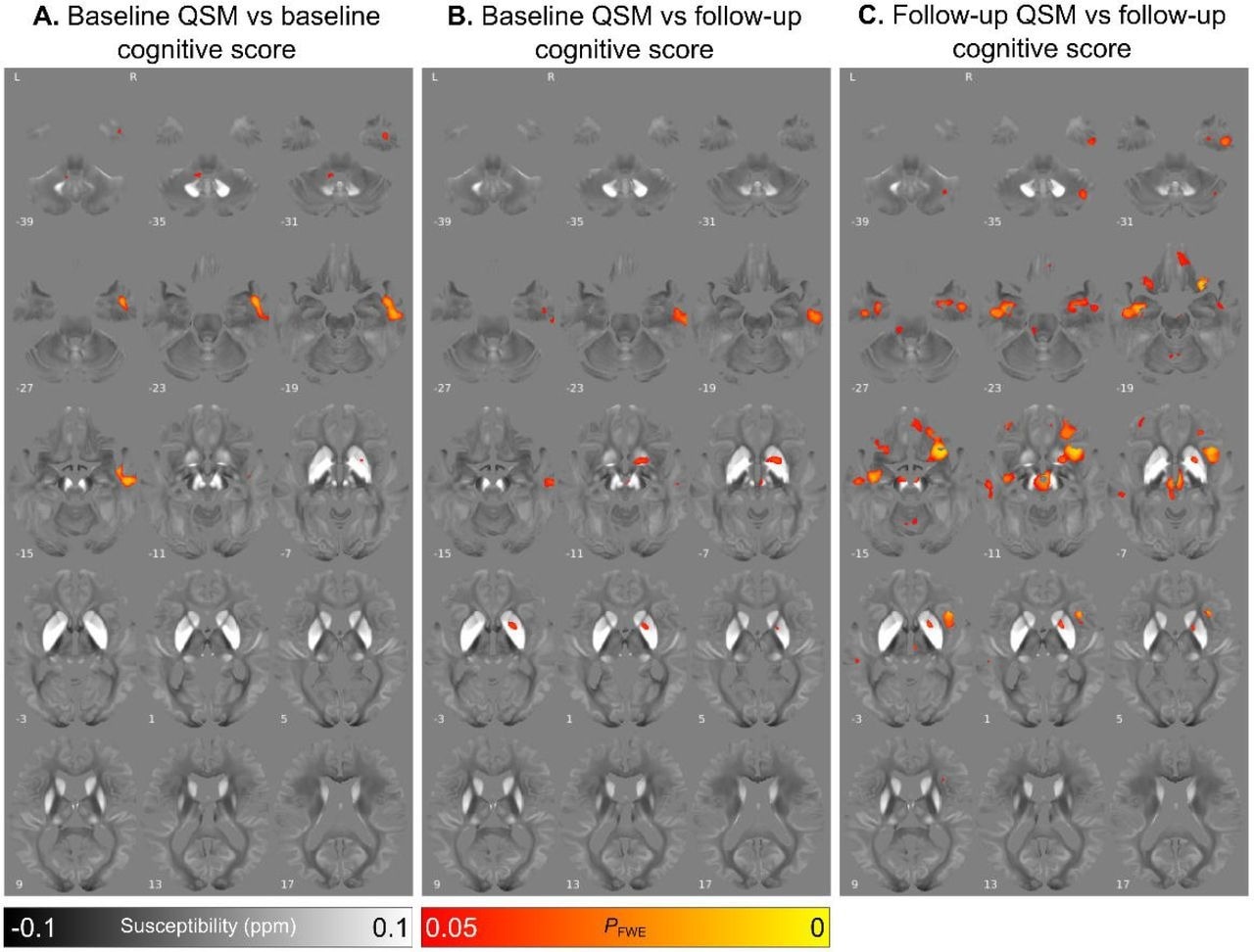 Relationship between elevated absolute magnetic susceptibility and declining cognitive capability over the Parkinson’s illness course, in a complete mind evaluation. A. Affiliation between baseline susceptibility and composite cognitive rating at baseline, adjusted for age at baseline and intercourse. B. Affiliation between baseline susceptibility and composite cognitive rating at 3-year follow-up, adjusted for age at baseline, intercourse and time between scans . C. Affiliation between susceptibility at 36-month follow-up and composite cognitive rating at 3-year follow-up, adjusted for age at follow-up and intercourse. Outcomes are overlaid on the study-wise QSM template in MNI house, and numbers signify axial slice location in MNI house. Left facet is proven on the left. Pink/yellow clusters signify voxels the place a big relationship was seen at FWE-corrected P<0.05.
Within the longitudinal analyses, all baseline susceptibility adjustments predictive of cognitive deficits and motor decline in PD sufferers turned robustly related and extra widespread throughout different related mind areas. Nevertheless, the ROI evaluation didn’t determine marked magnetic susceptibility worth will increase over time, even in related mind areas.
Prior longitudinal research utilizing QSM to guage PD sufferers failed to point out harmonious temporal will increase in signed susceptibility values and centered extra on motor outcomes, slightly than cognitive declines.
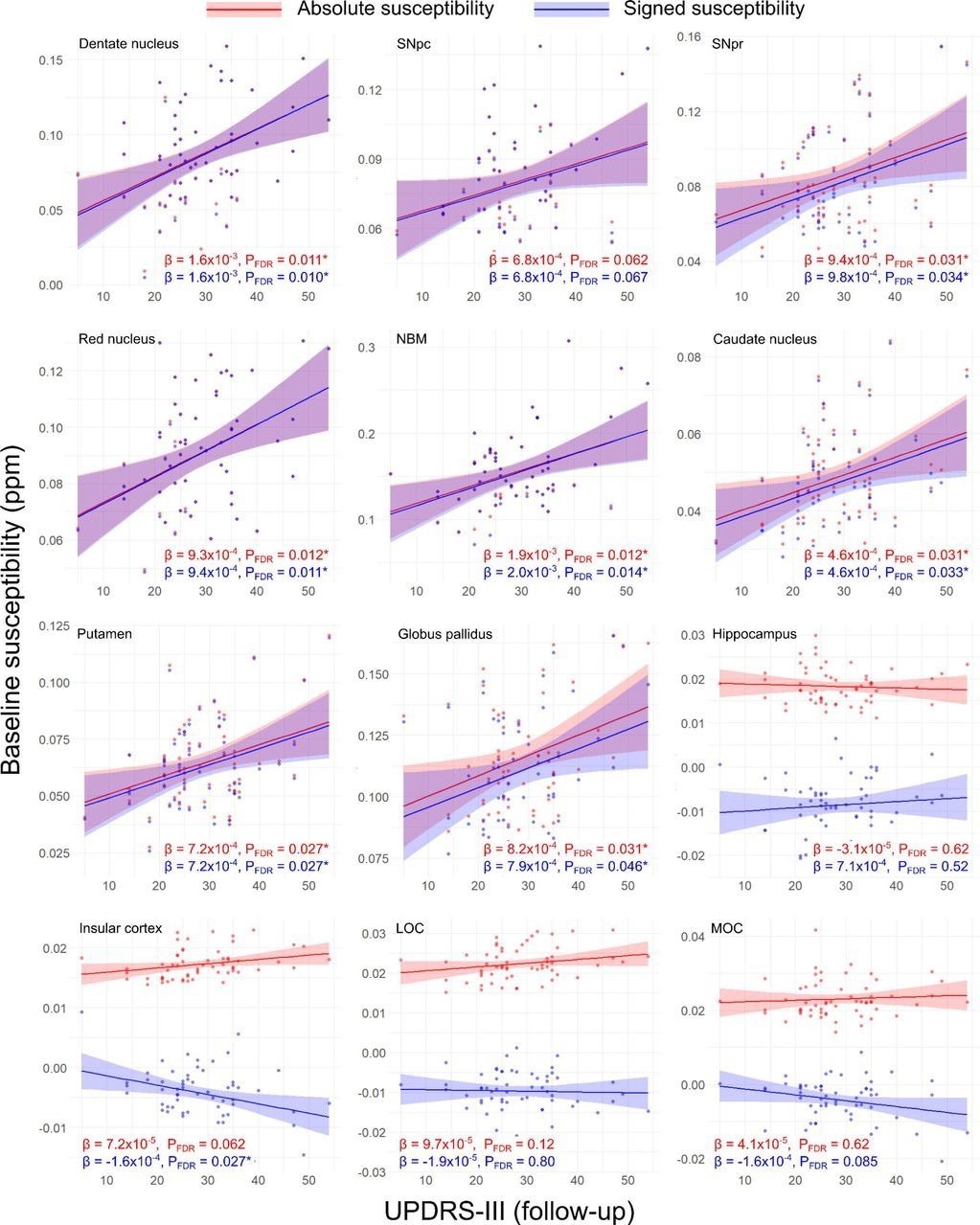 Regional relationships between baseline magnetic susceptibility and follow-up motor severity rating in PD. Information and statistics referring to absolute magnetic susceptibility are proven in purple, and people referring to signed susceptibility are proven in blue. Outcomes are adjusted for age at baseline, intercourse and time between scans. FDR-corrected p-values (PFDR) are offered, with asterisks indicating important interactions at PFDR < 0.05. β is the linear mannequin coefficient related to MDS-UPDRS-III rating. SNpc/pr = substantia nigra pars compacta / pars reticulata; NBM = nucleus basalis of Meynert; MOC = medial orbitofrontal cortex; LOC = lateral orbitofrontal cortex; MDS-UPDRS-III = Motion Problems Society Unified Parkinson's Illness Ranking Scale half III.
conclusions
The present longitudinal research used a whole-brain method and extra delicate measure of cognitive severity to find out that magnetic susceptibility might extra successfully predict cognitive and motor severity adjustments over three years of PD development. Nevertheless, strong regional will increase in susceptibility have been noticed, thus suggesting that this method could be extra restricted in predicting illness adjustments over time.
The entire-brain evaluation outcomes indicated that elevated baseline susceptibility in the proper NBM was predictive of poorer cognitive efficiency on the three-year follow-up that concerned bilateral hippocampi, temporal cortex, purple nucleus, and orbitofrontal cortices.
Future research are wanted to mix imaging modalities delicate to myelin and the buildup of pathological proteins, akin to tau, to differentiate between the particular tissue adjustments noticed in PD-related dementia and the way these relate to measures of scientific severity.
*Essential Discover: medRxiv publishes preliminary scientific stories that aren’t peer-reviewed and, due to this fact, shouldn’t be considered conclusive, information scientific follow/health-related conduct, or handled as established data.
Journal reference:
- Preliminary scientific report.
Thomas GEC, Hannaway N, Zarkali A, et al. (2023). Magnetic susceptibility is predictive of future scientific severity in Parkinson’s illness. medRxiv. doi: 10.1101/2023.07.12.23292555.
