

A latest examine posted to the bioRxiv* preprint server helps utilizing mosaic sarbecovirus receptor-binding area (RBD)-nanoparticles to find therapeutic pan-variant and pan-sarbecovirus monoclonal antibodies (mAbs) and to induce mAbs by vaccination.
Research: Neutralizing monoclonal antibodies elicited by mosaic RBD nanoparticles bind conserved sarbecovirus epitopes. Picture Credit score: Naeblys/Shutterstock
Background
Evaluation of the variability of RBDs between sarbecoviruses and inside extreme acute respiratory syndrome coronavirus 2 (SARS-CoV-2) variants of curiosity (VOIs) and variants of concern (VOCs) means that vaccines and mAbs addressing the extremely conserved neutralizing antibody epitopes, ie , class 4 and sophistication 1/4, can safeguard from the present and future SARS-CoV-2 VOCs and cease forthcoming sarbecovirus spillover incidents from inflicting one other pandemic or epidemic.
The present examine’s authors beforehand illustrated a vaccine technique involving the parallel show of sarbecovirus RBDs on protein-based nanoparticles. This method demonstrated improved heterologous adhesion, neutralization, and immunity from sarbecovirus challenges in animal fashions in contrast with homotypic, ie, SARS-CoV-2 RBD-only, nanoparticles.
Concerning the examine
Within the current investigation, the researchers from Beckman Analysis Institute of Metropolis of Hope, the California Institute of Know-how and Stanford College evaluated the RBD epitopes of mAbs derived from mosaic (SARS-CoV-2+seven animal sarbecovirus spike (S)) RBD- and homotypic (ie, SARS-CoV-2-only) RBD-immunized mice to profile the antibody reactions to RBD nanoparticles.
The group developed multimerized RBD-nanoparticles by covalently attaching RBDs to C-terminal SpyTag003 sequences using the SpyCatcher-SpyTag platform to a 60-mer nanoparticle, ie, SpyCatcher003-mi3. They established and described nanoparticles containing randomly ordered RBDs from seven animal sarbecovirus and SARS-CoV-2 Ss known as mosaic-8 RBD-mi3, in addition to nanoparticles comprising solely SARS-CoV-2 RBDs, often known as homotypic SARS-CoV- 2 RBD-mi3.
The authors first examined the adhesion of 13 purified mAb immunoglobulin Gs (IgGs) to SARS-CoV-2 variants and different sarbecoviruses RBDs using enzyme-linked immunosorbent (ELISAs) exams. They analyzed the mAb adhesion traits to 4 human anti-RBD IgGs with established epitopes: C118, sotrovimab (S309), C102, and C144. They performed subsequent assessments utilizing seven mAbs obtained from IgG-secreting B cells coupled to 2 or extra RBDs in screening.
Utilizing a pseudovirus neutralization analysis, the investigators assessed the mAbs neutralization capacities of sarbecoviruses leveraging human angiotensin-converting enzyme 2 (ACE2) for goal cell entrance. These sarbecoviruses embrace SARS-CoV-2 Beta, WA1 D614G, Omicron BA.2 and BA.1 and Delta variants, SARS-CoV, SHC014, WIV1, a modified LyRa3/SARS-CoV Chimera, and BtKY72 Khosta2/SARS-CoV Chimera . They performed a binding experiment to find out potential competitors with proteins that connect to acknowledged RBD epitopes to search out RBD epitopes focused by the mAbs.
The group performed structural investigations of the seven mAbs proven to bind two or extra RBDs in Beacon isolation to find out recognition and neutralizing processes. Moreover, the contacts of HSW-2 mAb (derived from homotypic SARS-CoV-2 RBD nanoparticle-immunized mice) with the S trimer have been examined utilizing single-particle cryogenic-electron microscopy (cryo-EM).
The authors examined the fragment antigen-binding (Fab)-bound S trimer constructions they discovered with different trimer constructions to discover the potential impression of mAb attachment with S trimer conformation. The scientists plotted the adhesion epitopes of the mAbs for which they obtained Fab-S configurations relative to the positions of Omicron BA.2 and BA.1 alterations on the RBD to delineate how alterations in latest VOCs would have an effect on the binding of these mAbs. Moreover, they used modeling to find out how the RBD nanoparticles employed to elicit the mAbs at present assessed would work together with bivalent B cell receptors.
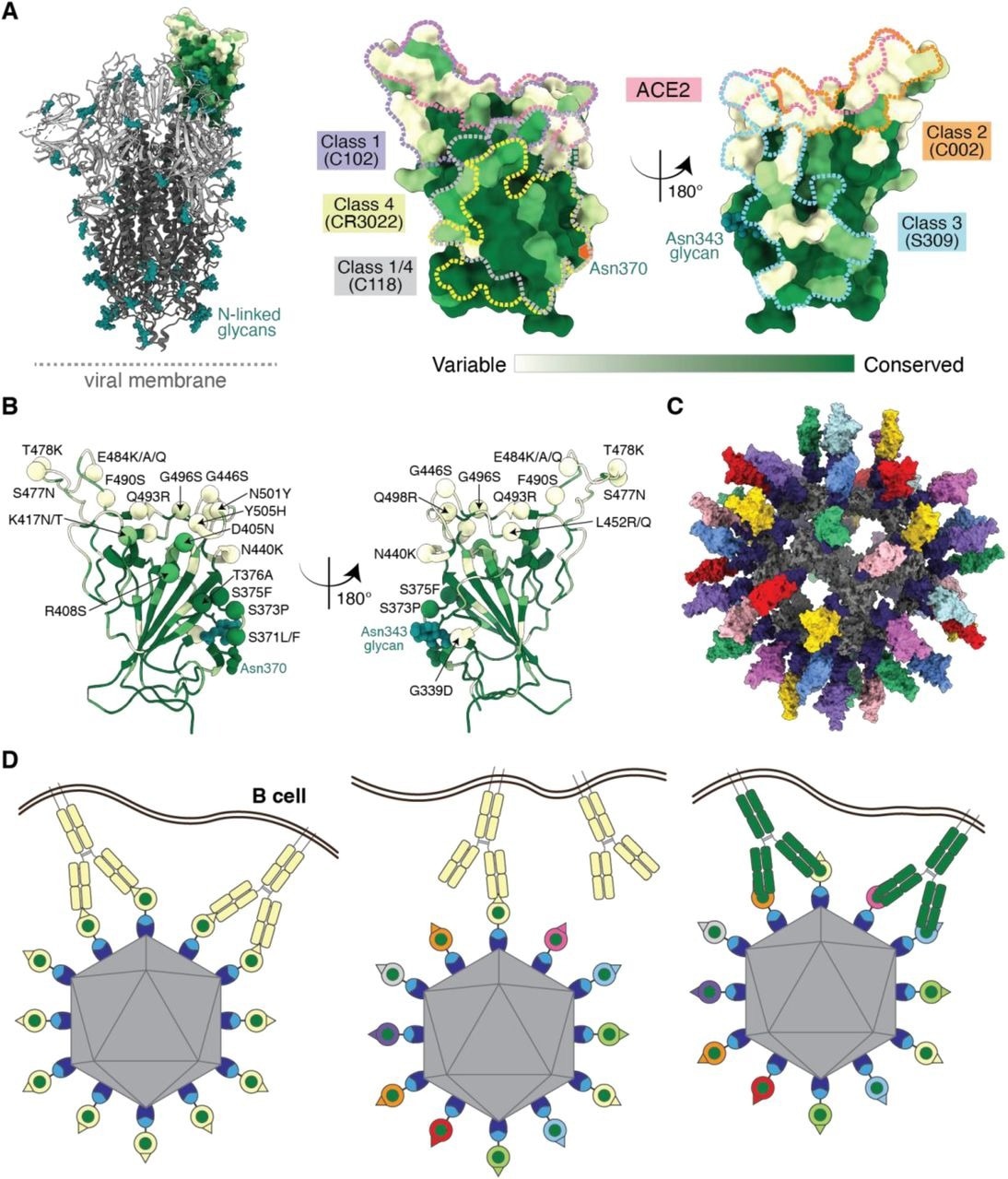
Using antibody avidity results suggests a method to focus on antibodies to conserved areas of sarbecovirus RBDs. (A) Left: Construction of SARS-CoV-2 spike trimer (PDB 6VYB) with one RBD in an “up” place. Proper: Sequence conservation of 16 sarbecovirus RBDs (Determine S1) calculated by the ConSurf Database (Landau et al., 2005) plotted on a floor illustration of the RBD construction (PDB 7BZ5). Class 1, 2, 3, 4, and 1/4 epitopes are outlined in several coloured dots utilizing data from constructions of the consultant monoclonal antibodies sure to RBD or spike trimer (C102: PDB 7K8M; C002: PDB 7K8T, S309: PDB 7JX3 ; CR3022: PDB 7LOP; C118: PDB 7RKV). (B) RBD mutations of 13 SARS-CoV-2 VOCs and VOIs (https://viralzone.expasy.org/9556) plotted onto the RBD construction (PDB 7BZ5) as spheres which can be coloured based on the variability gradient in panel A The N-linked glycan at place 343 of SARS-CoV-2 RBD is proven as teal spheres, and a possible N-linked glycosylation website at place 370 (SARS-CoV-2 numbering) present in some sarbecovirus RBDs however not within the SARS-CoV-2 RBD is indicated by an orange hexagon. (C) Structural mannequin of mosaic-8 nanoparticle shaped by SpyCatcher-mi3 and eight SpyTagged RBDs made utilizing coordinates of an RBD (PDB 7SC1), mi3 (PDB 7B3Y), and SpyCatcher (PDB 4MLI). (D) Speculation for preferential stimulation of B cells with that encode cross-reactive antibodies by mosaic (proper) versus homotypic (left) RBD nanoparticles. Left: Yellow B cell receptors recognizing an accessible strain-specific epitope (yellow triangle) can crosslink between adjoining RBDs on a homotypic nanoparticle to boost binding by avidity results. Center: Yellow B cell receptors in opposition to a strain-specific orange epitope can not crosslink between adjoining RBDs on a mosaic RBD nanoparticle that presents completely different variations of the epitope (coloured triangles). Proper: Inexperienced cross-reactive B cell receptors can crosslink between a conserved epitope (inexperienced circles) on adjoining RBDs in a mosaic RBD nanoparticle to boost binding to a extra occluded, however conserved, epitope by avidity results.
Outcomes and conclusions
The examine outcomes demonstrated that mosaic sarbecovirus RBD-nanoparticles triggered sturdy neutralizing antibodies that cross-react amongst SARS-CoV-2 VOCs and animal sarbecoviruses.
Though the group found simply 5 mAbs from mosaic-8 nanoparticle-immunized mice that coupled to 2 or extra RBDs, one mAb, ie, M8a-3, was potently neutralizing and cross-reactive. Furthermore, two others, ie, M8a-34 and M8a-31, have been much less strongly neutralizing but have been cross-reactive. Moreover, one other mAb, ie, M8a-28, robustly neutralized SARS-CoV-2 variants and was just like therapeutic antibodies in current use, eg, Bebtelovimab. These findings illustrated the capability of the mosaic-8 immunogen to successfully induce presumably useful therapeutic antibodies that may very well be acknowledged in in depth assessments and established as future therapeutic mAbs.
Structural analyzes of Fab-SARS-CoV-2 S trimer complexes, reminiscent of one with Omicron BA.1, indicated that 4 out of 5 mAbs derived from mosaic-8 immunized mice recognized conserved epitopes, as devised within the immunization technique and as demonstrated for polyclonal antisera generated in mice through mosaic-8 RBD nanoparticle immunization. Contrariwise, antibodies from mice immunized with homotypic SARS-CoV-2 RBD-nanoparticle extra steadily recognized variable class 2 and 1 RBD epitopes. This inference in all probability explains why it was tougher within the current examine to extract single B cells from homotypic SARS-CoV-2 RBD-nanoparticle-immunized mice (HSW) that secreted IgGs coupled with two or extra labeled RBDs.
The 2 cross-RBD attaching mAbs that the researchers remoted from mice immunized with homotypic RBD nanoparticle exhibited adherence to quite a few sarbecovirus RBDs but have been both poorly or non-neutralizing. Structural analyzes defined the HSW mAbs’ poor neutralization traits. In distinction to the constructions of extra powerfully neutralizing mAbs, which revealed three connected Fabs for every trimer, the HSW-1-S configuration solely displayed one connected Fab per trimer. Additional, a trimer separation and a Fab-monomeric S1 subunit construction resulted from the HSW-2 Fab epitope’s incapacity to bind to its RBD epitope on an intact S trimer.
Altogether, the present findings, mixed with the prior experiences, reinforce the mosaic-8 RBD-nanoparticles as a possible vaccine choice to safeguard from potential spillover sarbecoviruses from animal hosts and SARS-CoV-2, together with future variants. Moreover, since environment friendly cross-reactive mAbs have been acknowledged from fewer B cells, a high-throughput evaluation of large-scale samples from mosaic-8 RBD-mi3-immunized animals may very well be employed in figuring out various medical mAbs. These mAbs then may help in treating or stopping SARS-CoV-2 Omicron or future variant infections.
*Essential discover
bioRxiv publishes preliminary scientific experiences that aren’t peer-reviewed and, due to this fact, shouldn’t be considered conclusive, information medical apply/health-related habits, or handled as established data.
Journal reference:
- Neutralizing monoclonal antibodies elicited by mosaic RBD nanoparticles bind conserved sarbecovirus epitopes; Chengcheng Fan, Alexander A Cohen, Miso Park, Alfur Fu-Hsin Hung, Jennifer R Keeffe, Priyanthi NP Gnanapragasam, Yu E Lee, Leesa M Kakutani, Ziyan Wu, Kathryn E Malecek, John C Williams, Pamela J Bjorkman. bioRxiv preprint 2022, DOI: https://doi.org/10.1101/2022.06.28.497989, https://www.biorxiv.org/content material/10.1101/2022.06.28.497989v1
